O que você está procurando
?
Qual a melhor lente para sistemas de visão robótica?
Apr 03, 2026Escolher a lente certa para um sistema de visão robótica não se resume apenas a obter uma imagem nítida — isso impacta diretamente... precisão, percepção de profundidade e confiabilidade do sistemaSeja para construir um braço robótico para inspeção, operações de pegar e colocar ou automação orientada por IA, a lente desempenha um papel fundamental no desempenho do sistema em condições reais.
Neste guia, vamos explicar como escolher o Melhor lente para sistemas de visão robótica, com base em necessidades práticas de engenharia, em vez de especificações genéricas.
Em muitos projetos, as equipes se concentram bastante em sensores e algoritmos, mas negligenciam a lente. Na realidade, a lente define:
Uma lente mal escolhida pode introduzir distorção, reduzir a nitidez das bordas ou limitar o campo de visão, levando a erros de detecção e posicionamento.
Diferentes aplicações exigem diferentes abordagens ópticas. Algumas das opções mais comuns incluem:
Esses dispositivos são amplamente utilizados para inspeção básica e detecção de objetos. Funcionam bem quando a percepção de profundidade não é necessária.
Quando seu robô precisa monitorar uma área maior — como esteiras transportadoras ou ambientes com múltiplos objetos — um Lente grande angular para visão robótica Ajuda a expandir a cobertura sem adicionar mais câmeras.
Para aplicações que exigem percepção de profundidade, como braços robóticos e posicionamento 3D, Lentes de visão estéreo para robôs São essenciais. Elas permitem a detecção de profundidade capturando duas imagens sincronizadas, possibilitando que o sistema calcule a distância com precisão.
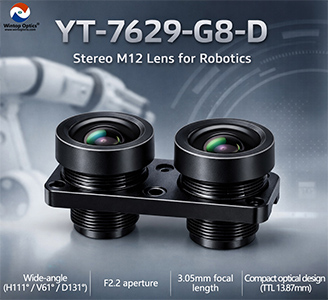
A distância focal determina a largura ou a estreiteza do seu campo de visão.
Para braços robóticos, o equilíbrio é fundamental: cobertura suficiente para visualizar a área de trabalho, mas com detalhes suficientes para um posicionamento preciso.
A distorção é um dos fatores mais negligenciados na visão robótica.
A Lente de baixa distorção para visão computacional Garante que as linhas retas permaneçam retas e que as medições permaneçam precisas. Isso é especialmente importante em:
Em sistemas robóticos de grande angular, lentes com distorção inferior a -18% são frequentemente preferidas para manter a precisão geométrica.
As condições de iluminação em ambientes industriais podem variar significativamente.
Uma lente com uma abertura como F2.2 Oferece um bom equilíbrio entre entrada de luz e profundidade de campo, tornando-o adequado tanto para condições de iluminação controlada quanto semivariável.
A compatibilidade entre a lente e o sensor é crucial.
A Lente otimizada para CRA para sensores Garante uma distribuição de luz adequada em toda a imagem, melhorando a nitidez das bordas e reduzindo o efeito de vinheta. Isso se torna especialmente importante ao trabalhar com sensores compactos, como os usados em sistemas robóticos embarcados.
Em robótica, o espaço é frequentemente limitado.
A Lente compacta para sistemas robóticos Com um comprimento total (TTL) menor, a integração é mais fácil, especialmente em braços robóticos ou espaços confinados. Interfaces padrão como Lentes M12 para câmeras robóticas Também simplificam a instalação e a substituição.
Nem todas as lentes são fabricadas para ambientes industriais.
Se o seu sistema opera em condições adversas, escolher um lente da câmera com classificação IP69 podem fazer uma diferença significativa. Estes lentes ópticas de nível industrial são projetados para resistir a:
Isso é especialmente importante para aplicações como automação industrial, processamento de alimentos ou robótica para ambientes externos.
Então, qual lente é a melhor para sistemas de visão robótica?
A resposta depende da sua aplicação, mas, em geral, uma solução ideal deve oferecer:
Por exemplo, em sistemas de visão de braços robóticos que requerem percepção de profundidade, um Configuração de lente estéreo com baixa distorção, ampla cobertura angular e proteção industrial. é frequentemente a opção mais eficaz.
Selecionar o certo lente de visão robótica Não se trata de escolher as especificações mais altas, mas sim a combinação certa de óptica, mecânica e durabilidade para o seu caso de uso específico.
Ao entender como fatores como distância focal, distorção e resistência ambiental afetam o desempenho, você pode construir um sistema de visão mais confiável e preciso desde o início.
Se você está trabalhando em um sistema de visão robótica e precisa de ajuda para selecionar a lente correta, estamos aqui para te apoiar.
No Óptica Wintop, somos especializados em Lentes personalizadas para visão robótica, soluções de lentes estéreo e design de lentes M12 para aplicações industriais.—feito sob medida para atender às suas necessidades específicas.
Telefone/WhatsApp: +86 153 0268 9906
E-mail: yorty@yuntal.com
Fique à vontade para entrar em contato — teremos prazer em ajudá-lo a encontrar a solução óptica ideal para o seu projeto.
 Inscreva-se em nossos boletins informativos
Telefone : Overseas contact Lina : 86 153-0268-9906
Overseas emial : yorty@yuntal.com
WhatsApp : +86 153-0268-9906
E1108, Jinbolong Building, Longhua, Shenzhen,Guangdong, China


Friendly Links :
whatsappdireito autoral © 2026 WINTOP OPTICS CO., LTD.. Todos os direitos reservados .粤ICP备2025439823号-1
 IPv6 network supported.